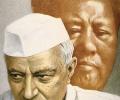
'Delhi was not concerned.' 'It would continue sleeping for several more years, with the result that Indian territory is still occupied by China today,' says Claude Arpi.

China has established a new county in Xinjiang province near Pakistan-occupied Kashmir (PoK) and the Afghanistan border, a move seen as strengthening security along the Wakhan Corridor and addressing concerns about Uyghur separatist militants.

China is set to build a rail link connecting Xinjiang province with Tibet, part of which will run near the Line of Actual Control (LAC) with India.
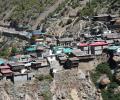
On August 5, 1953, Jawaharlal Nehru sent a strange note to the foreign secretary. It is worth mentioning because it was symptomatic of the lack of knowledge about Western Tibet in India and in South Block in particular, notes Claude Arpi.
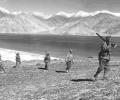
As India and China continue to face off across the Himalayas six decades later, the echoes of that earlier conflict remain unmistakable. The core of China's sensitivity lies not in maps or mountain passes, but in its perception of sovereignty over Tibet, points out Dr Kumar.
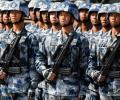
'The unfortunate truth is that China, having exploited the initiative to seize pieces of India's claimed territory, can now hold on to its new acquisitions forever unless India chooses to eject Chinese troops by force or decides to impose tit-for-tat costs on China by symmetrically occupying other pockets in disputed territory where it possesses a tactical advantage'

Overall, the People's Liberation Army Air Force (PLAAF) has focused on building ground-based air defense networks and network-centric operations rather than trying to match the Indian Air Force (IAF) in terms of straight fighter numbers along the border. All air assets fall under the Western Theater Command of the PLA, the largest geographic region of China's five military theater commands.

Nearly two decades ago, then defence minister George Fernandes said: 'China has built roads up to the border, while there has been negligence on India's part.' Since Fernandes uttered these brave words, what has been done on the Indian side? The Modi Sarkar is apparently trying, but little has been achieved so far, says Claude Arpi.
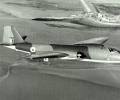
'If we had sent a few airplanes (into Tibet), we could have wiped the Chinese out.' 'And everything could have been different in the 1962 War.' 'They did not believe me there was no Chinese air force.' 'Can you imagine what would have happened if we had used the IAF at that time?' 'The Chinese would have never dared do anything down the line.'
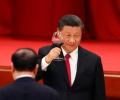
After the Ladakh fiasco where Xi Jinping did not expect the Indian Army to resist his land-grabbing tactics, he has to save face before his colleagues in the Communist party.' To bring the threat of a mega-dam to the northern Indian border is a clever move, observes Claude Arpi.
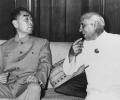
'Unquestionably, the spirit behind the Panchsheel agreement and the 'Hindi Chini bhai bhai' slogan were thrown overboard by the Chinese, and a trust deficit was injected between the two nations.' A revealing excerpt from General J J Singh's The McMahon Line: A Century Of Discord.

Xi and Modi met soon after their arrival at a summit of the BRICS group of emerging powers. Xi said the two countries should join hands in setting global rules and suggested he attend the November meeting of the 21-nation APEC in Beijing, as well as take part in Chinese-led regional initiatives.
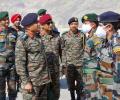
'China is playing the big global game.' 'Their ambitions lie far beyond the Line of Actual Control.'
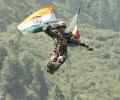
So far, the Central Sector has never seen active hostilities, remaining peaceful even through the 1962 war. A reason for the Central Sector having remained peaceful is the towering Himalayan watershed that defines the border.

'Clearly, there is a wide gap between the stated intentions of China's top leadership to improve relations with India and the PLA's aggressive border management,' says Brigadier Gurmeet Kanwal (retd).

'These tactics are particularly evident in China's pursuit of its territorial and maritime claims in the South and East China Seas as well as along its border with India and Bhutan'
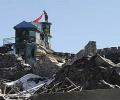
Public interest centres on whether the two leaders might make headway in resolving the Sino-Indian boundary dispute.

'Does the Indian army's new assertiveness risk a clash escalating into shooting and possibly skirmishes?' asks Ajai Shukla.

'The need of the hour is to build on the positives and control the negatives,' says Colonel (Dr) Anil A Athale (retd).

Chinese President Xi Jinping has bestowed special honours on a PLA battalion posted in Tibet close to Arunachal Pradesh for its "outstanding performance in safeguarding borders".
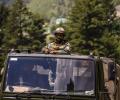
'Our biggest advantage is that the troops are much better trained and motivated than the Chinese and can improvise and manage with a part of the resources.'

'It is flabbergasting to think that this heavenly region has, for decades, been coveted by India's aggressive neighbours,' says Claude Arpi after a recent visit to Ladakh. 'Wanting to use the newly created infrastructure to defend the borders after the clash of 2020 with China and the resulting standoffs, the home ministry is keen to boost border tourism to show that these areas are controlled by India.'

'Ensuring through diplomatic means and in conjunction with strategic partners that India will not be required to fight a simultaneous two-front war with China and Pakistan.' Brigadier Gurmeet Kanwal (retd) lists what India must have in its national security strategy.
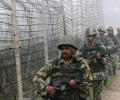
Most of India's reserves for war in the mountains have been sucked in by the standoff with China. A large part of India's airpower has also similarly been committed on the eastern border. By moving these reserves to the China border, India has been weakened vis-a-vis Pakistan. All in all, the nightmare scenario for India of a two-front war may well come true, warns Colonel Anil A Athale (retd).

'This is potentially escalatory, as China does not believe that India has any basis for interfering in a bilateral dispute between China and one of its neighbours.'

The seventh Tibet Work Forum was held in Beijing on August 28 and 29. Delhi should be deeply concerned, at a time India faces a precarious situation in Ladakh, because the TWF also defines China's western border policies, observes Claude Arpi.

Claude Arpi's fascinating account of the Dalai Lama's arrival in Tawang in March 1959.
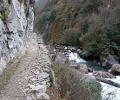
'It is certainly time for New Delhi to open up. Not only should it go ahead at full steam with the roads to the LAC, but the government must also allow tourists to visit these stunningly beautiful areas of Indian territory.'
Claude Arpi gives a fascinating firsthand account of the Dalai Lama's arrival in Tawang in March 1959 and explains why he will once again receive a grand welcome, whether Beijing likes it or not.

'How can a State, which claims to be a responsible power, unilaterally grab a "disputed" area to build a road on it?' asks Claude Arpi.
